The future of Google Ads
A post-click concept where Gemini helps local owners show what sets them apart.

Eight plumbers, all 4.7 stars.
Search “emergency plumber” and you get eight businesses that look the same: a name, a rating, a distance, a price band. One of them answers the phone at eleven at night. One has been on the same street for thirty years. One sends the owner, not a subcontractor. The searcher has to choose in the next ten seconds, and nothing on the screen says which one fits.
The differences are real, and Google already holds the evidence for most of them: in reviews, photos, hours, verification, the website, the questions people ask. What was missing was a place to show that evidence at the moment of choice. Google’s brief named the symptom: a set of post-click experiences that worked but did not add up, next to organic Viewers that had already become immersive and context-rich. The answer was a universal Viewer template. I delivered the first phase of the initiative, strategy, discovery and concepts, to make that future feel real, and to ask what the template was for.
Knows exactly why her business is different.
She cannot say it in a tool built for marketers (fifteen headlines, a final URL, a strength meter), and she will not maintain it.
Needs to know why, now.
He distrusts sponsored results, expects spam, and wants prices, photos and verified reviews before he acts.
Sits between them.
Holding the evidence both of them need, and showing almost none of it after the click.
Let the business speak for itself.
The post-click Viewer is not a landing page. It is the one place where a business can answer “why this one?” with evidence, for this searcher, right now. The concept makes that the Viewer’s job, and gives the owner a way to put what she knows in front of searchers without becoming a marketer: Gemini drafts every part of the Viewer from what Google already knows, in the owner’s voice; the owner confirms, corrects and adds the one or two things only she knows; and the Viewer re-assembles itself for each search so the proof that matters most arrives first.
Recognize, don’t author.
Nobody writes from a blank field. The first screen is a finished storefront drafted from evidence; the owner’s work is to say “yes, that’s us”, fix what is wrong, and add the line only she can write.
Answer the search, not the category.
One approved Viewer, assembled per query and entry point: the tiramisu reviews on a dessert search, night availability on an emergency, the quote form with the license on a repair. Specifics are what differentiation feels like.
Say only what can be cited.
Every claim traces to a source the owner can see and the searcher can trust. Photos are tidied, never staged. Verification, pricing and real photos never leave the first screen. Anything automatic is labelled, previewable and reversible.
A storefront you recognize, not a form you fill in.
Five moments, one owner. Gemini drafts and keeps working; she recognizes, approves and undoes. She never starts from an empty page.
The first screen is a finished storefront.
Gemini builds the Viewer from what Google already holds: Business Profile, photos, reviews, the website. The owner confirms five things, each with its source, and she is live.


Your Viewer is ready, desktop and mobile.
Blocks named the way searchers see them.
Your offer, your photos, why people trust you — not ad-unit vocabulary. Select a block and Gemini proposes the next improvement; the owner picks one, and can undo it.


The block editor, desktop and mobile.
Light and crop happen. Anything more waits.
Brightening, straightening and cropping apply on their own. Removing clutter or swapping a photo waits for a yes, and nothing is ever added to a dish, a room or a person.


We tidied your photos, desktop and mobile.
See the real search before a dollar is spent.
The owner sees her ad in live results and her Viewer by intent: dinner, catering, lunch. She chooses which automatic behaviours keep running, then publishes.


Preview in market, desktop and mobile.
Every automatic change is a card she can undo.
Tidied photos, a new review highlight, a seasonal offer: each arrives with keep or undo, beside what searchers responded to. The work continues without the owner becoming a marketer.


Gemini did this: Business Profile on desktop, the Google Business app on mobile.
The same business, the right first screen.
One template, assembled for the search. The same Viewer is a sheet on the phone and a side panel on desktop, so it reads as part of Google, not as an ad.
A dessert search opens on dessert.
Nonna’s Table leads with the tiramisu, what people say about it and a table to reserve. Ask about this place answers from the menu and reviews, with sources.


The Viewer on a discovery search: a side panel on desktop, a sheet on mobile.
An urgent search opens on availability.
Northline Plumbing leads with who can come tonight, starting prices and a call button. The quote form waits for the person who is not in a hurry.


The Viewer on an urgent search: a side panel on desktop, a sheet on mobile.
A form ad opens on the form.
Ridgeway Motors leads with the test-drive booking, pre-filled and sent only when the searcher books. Inventory and reviews follow for anyone still deciding.


The Viewer from a form ad: a side panel on desktop, a sheet on mobile.
The concept, as a system.
What would have to exist for the idea to work, written for the teams that would build it, at the level a roadmap needs.
Business Profile (name, category, hours, attributes) · verification and licenses · reviews and the questions searchers ask · photos from the owner, from customers and from menu scans · a crawl of the website, where one exists · the campaign objective and history · outcomes inside the Viewer (calls, messages, bookings, directions, forms completed).
Gemini drafts from the inputs only, with a source on every line. The owner confirms, corrects and adds; manual editing is always one tap away and never the first thing shown. The system labels every automatic change, previews it behind a real search and keeps an undo. The searcher receives one Viewer per query; assembly at query time may reorder and emphasize, never add a claim.
When a business starts (a campaign created, a verification passed, a profile with enough signal opting in): draft the Viewer; review, then publish. When something about the business changes (a new photo, a new review, hours, menu, season, a performance dip): tidy, refresh, update, suggest, tune; minor changes apply themselves, anything a searcher would notice waits for a tap. When someone searches (query, entry point, context): order the blocks, match the photo and the service, surface the relevant reviews, answer questions from the approved Viewer only; no checkpoint, because nothing new is claimed. When the owner asks, in plain words: three options with reasons; the owner picks one.
Enhance, never fabricate, with an “enhanced” disclosure available to searchers · claims only from confirmed sources · the three trust blocks pinned to the first screen · vertical compliance inside the blocks (health, legal, finance) · every automatic change logged and reversible · query-time assembly bounded by what the owner approved.
For the searcher: actions inside the Viewer per impression (call, message, booking, directions), time to first action, spam reports and dismissals. For the owner: time from campaign start to a published Viewer, the share of drafted blocks confirmed without edits, owners returning to the inbox week over week, Viewer strength against outcomes. For Google: advertisers publishing a Viewer with no website of their own, in-Viewer conversion beside website clicks, and whether fit, not budget, starts to win the comparison.
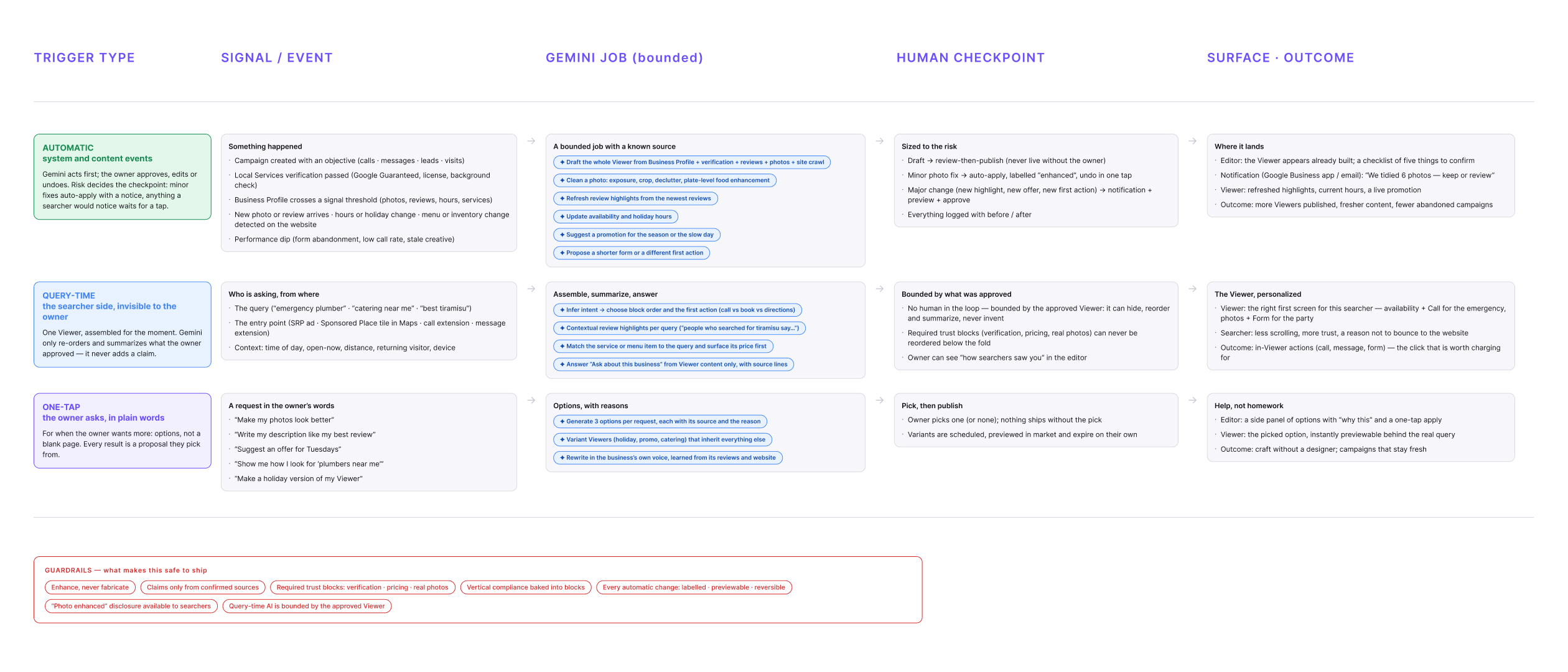
The four occasions on which Gemini acts, each with a checkpoint sized to its risk, and the guardrails underneath.
Differentiation is the product.
It answers the chargeability question.
A Viewer that converts in place is not a detour from the website; it is the destination, with the website one tap away. Charge the click, and show the advertiser what the click bought.
It is trust by construction.
The structural answer to spam fear is content that cannot be invented: drafted from sources Google holds, cited on the surface, confirmed by the owner. Trust stops being a disclaimer and becomes the format.
It widens who can advertise well.
A business with no website and no marketer gets a storefront on day one that is better than most websites, because it is assembled from evidence and kept current for her.
Cohesion becomes structural.
The editor can only fill the universal template, so every Viewer reads as a sibling of organic results; customization lives inside blocks and vertical packs, never in the frame.
Owners trust the draft: do they confirm more than they rewrite? If they rewrite everything, the voice is wrong.
Searchers feel the difference: does a first screen assembled for the query move actions against a fixed Viewer?
Photo enhancement holds its line: where is “tidied” versus “staged”, per vertical, and does the disclosure satisfy policy?
Query-time assembly is fast enough to be invisible and bounded enough to be safe.
The comparison rewards fit: when Viewer strength rises, do outcomes rise independent of bid?
Proposals from the first phase of the initiative, stated as what would have to be true. Which of them Google chose to test belongs to the teams carrying the work forward.
Concept-stage, stated plainly.
This was the first phase of the initiative: strategy, discovery and concepts. What exists: the searcher-side Viewer in high fidelity on the universal template, and, beyond the brief, the advertiser side: the editor, the automation, the trigger taxonomy and the rules, on Material 3 Expressive with Google’s product scheme, built against the Search Design System patterns Google provided. Fictional advertisers throughout; nothing Google-internal. The package went to Google’s leadership to stimulate next steps and a roadmap; outcomes belong to the teams carrying it forward.
Findings & Insights...
The brief asked about the searcher. The answer was about the owner.
The quality of the searcher’s experience is set by what the advertiser can put into it. Taking the brief’s own principles seriously led to the editor.
Specifics are what differentiation feels like.
A rating is a tie; a sentence about the tiramisu is a decision. The Viewer’s job is to get the specific, cited thing in front of the right searcher first.
The best use of Gemini here is editorial, not generative.
Read everything, write only what it can cite, and give the owner the last word. That is also the trust model.